
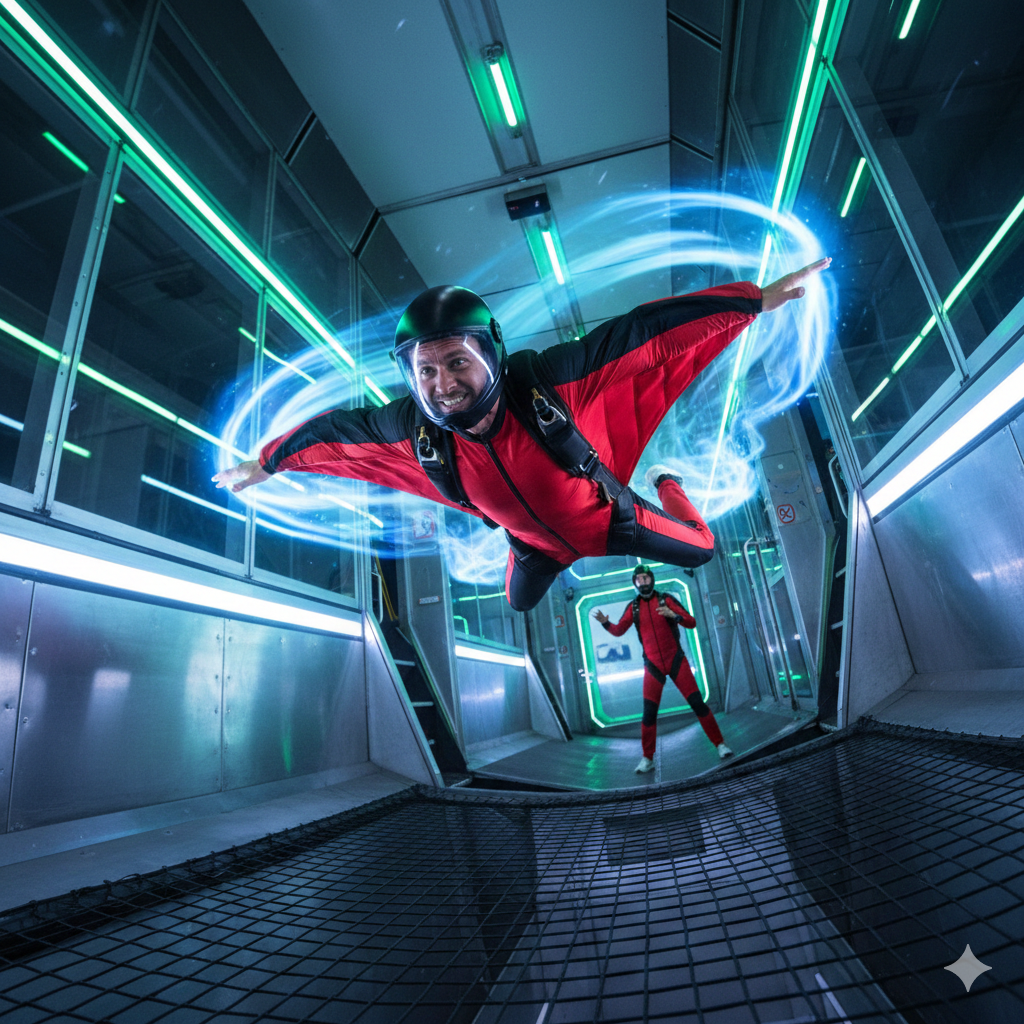
Indoor Wingsuit Flying: No Parachute Required
The complete guide to experiencing the rush of real human flight safely—zero skydives needed.
Introduction: The Gateway to Authentic Human Flight
The yearning to fly is etched into the deepest, oldest layers of human consciousness. It surfaces in the adrenaline dreamer as a visceral ache—the vision of pushing off a cliff edge, the canopy of nylon and air snapping taut, and the dizzying, impossible rush of trading freefall for flight. This is the draw of traditional wingsuiting: a magnificent, terrifying discipline where you become a human dart, skimming the earth at speeds that defy gravity’s usual cruel contract.
But the pursuit of that ultimate freedom is a terrifying gauntlet. It begins not with a cliff or a plane, but with the quiet, rigid mathematics of risk. To even attempt a wingsuit jump from an aircraft, safety organizations like the USPA mandate a minimum of 200 successful skydives, a time investment that costs thousands of dollars and often spans 1 to 3 years. This journey is a meticulous, humbling trial by air, designed to ensure you can survive when the sheer complexity of that extra nylon jacket turns an inconvenience into a catastrophe. As Espen Fadnes, one of the modern pioneers of human flight, once said, in the realm of extreme flying, “The day you fuck up is the day you die.” That reality—the unyielding stakes—is what makes the dream so compelling, yet so distant.
The Problem and The Solution: Flying Without the Fall
This dichotomy—the profound desire for flight set against the brutal, necessary barrier of entry and risk—is the wall facing the Affluent, Adrenaline-Curious Traveler. You possess the ambition, the means, and the deep-seated respect for safety, yet you cannot, or choose not to, dedicate years and thousands of jumps just to achieve the basic prerequisite for a wingsuit flight. Your problem is clear: you seek the ultimate, skills-based adrenaline experience, but you need a safe, time-efficient, and precise methodology to master the art of flight.
The solution, once reserved for the science fiction of training facilities, is here: Indoor Wingsuit Flying.
This revolutionary approach strips away the inherent dangers of exit collisions, deployment failure, and landing error, focusing solely on the pure mechanics of human flight. It is the safest, most accessible, and most technically precise method for mastering the intricate movements of wingsuiting. It is not a simulation; it is authentic, measurable, and repeatable flight, achieved with the security of a net beneath you and an instructor within arm’s reach.
Your Blueprint for Flight Mastery
This guide is your comprehensive blueprint. Written in the highly technical yet vivid style of an expert coach, it is engineered to transform you from a curious reader into a certified Indoor Flight Athlete. We will dismantle the gatekeeping of traditional skydiving and hand you the keys to the world’s few inclined tunnels.
In this authoritative guide, you will learn:
- How to fly a wingsuit without ever jumping from a plane: Decoding the physics of inclined flight.
- The exact cost and where to book the best training packages: The definitive financial and travel guide.
- Your “Zero-to-Wingsuit” progression plan: The actionable steps used by professionals to acquire genuine air skills.
This is where the risk is taken out of the equation, leaving only the pure, exhilarating focus on mastery. Welcome to the future of human flight.
The Physics of Safe Flight: What is Indoor Wingsuiting?
The secret to Indoor Wingsuit Flying isn’t magic; it’s precision engineering that finally cracked the core physics problem of human flight. If traditional wingsuiting is a terrifying plummet that requires a sudden change of direction, the indoor method is a continuous, controlled glide. It’s the difference between falling through a black void and maneuvering down a predictable river of air.
The Critical Difference: Inclined vs. Vertical Wind Tunnels
To grasp the revolutionary nature of the indoor wingsuit experience, you must first understand the technology it relies upon. The vast majority of indoor skydiving facilities—the popular iFLY centers—use vertical wind tunnels.
In a vertical tunnel, the air is pushed straight up, simulating terminal velocity in freefall. When you enter, your body, arms, and legs act as an airfoil, allowing you to float and move up and down. This is ideal for practicing belly-flying and basic acrobatics, but it fundamentally simulates falling, not flying.
The inclined wind tunnel, however, is a game-changer. Here, the air column is angled, often between $15^{\circ}$ and $25^{\circ}$. This intentional tilt allows the powerful fans to generate a strong horizontal component to the airflow, mimicking the actual forward speed needed to generate lift in a wingsuit. Instead of simply pushing you up, the air stream forces you forward and up, allowing you to use your wingsuit to translate vertical descent into controlled horizontal travel.
This distinction is why the inclined tunnel is considered the superior, safest option and the true benchmark among safe wingsuit alternatives. Think of it this way: the vertical tunnel is like floating on water (freefall simulation), while the inclined tunnel is like sailing a boat (actual gliding/flying simulation). It’s the only structure that lets you master the intricate body positioning and wing angle necessary to carve through the air, without the stress of an altitude meter.
Why the Parachute is Optional: Understanding the Safety Margin
The title of this article isn’t hyperbole—you truly don’t need a parachute, because the risk of catastrophic failure has been engineered out of the experience. This dedication to Safety Priority is what makes the niche so appealing to the affluent, detail-oriented professional.
The inclined tunnel is a closed, controlled ecosystem. The primary safety features are simple yet ingenious:
- Safety Netting: The entire chamber is lined with tensioned, high-strength netting. If you lose control or suffer a physical cramp, you simply fall a short distance onto a safety boundary.
- Instructor Presence: A highly skilled instructor is always inside the chamber with you, able to physically stabilize or assist you the instant you need it.
- Immediate Shut-off: The air column is controlled by technicians who can adjust speed or stop the airflow almost instantaneously, unlike the minutes required for a skydiving emergency.
- Controlled Environment: There are no mid-air collisions, no weather concerns, and no equipment malfunctions, eliminating the vast majority of variables that make traditional wingsuiting fatal.
This suite of safety measures is what creates the Zero-Risk Factor. The greatest danger you face is fatigue or perhaps a bump on the safety net—not equipment failure or proximity-to-earth error. This low barrier to entry for skill acquisition is why this is the only viable path for true Wingsuit flying for beginners.
Separating Fact from Fiction: Tandem Dreams and Simulation Realities
Many newcomers search for Wingsuit tandem flight, believing they can simply strap themselves to an expert and experience the rush immediately.
Here is the essential truth about the high-intent, low-supply dream: commercial, legal wingsuit tandems are extremely rare, if not entirely non-existent, in most major jurisdictions globally (including the U.S., Canada, and much of Europe). The inherent complexities and G-forces involved in stabilizing a wingsuit with a passenger make it fundamentally unsafe compared to standard skydiving tandems.
For all practical purposes, the inclined wind tunnel is not just an alternative; it is the only viable, legal, and repeatable “wingsuit experience” available to the non-skydiver.
While VR flight sims (using the supporting keyword Wingsuit simulation experience) are a fun, cheap way to visualize flight and practice mental conditioning, they lack the crucial feedback loops of physical resistance, G-forces, and required muscle memory that only real airflow provides. The tunnel is the lab where the theory becomes flesh.
The Training Roadmap: Your Zero-to-Athlete Progression
The path to becoming an Indoor Flight Athlete is not mystical; it is a meticulously designed progression that requires patience, discipline, and a respect for aerodynamics. Unlike the years spent qualifying for outdoor wingsuiting, the tunnel path is streamlined and optimized for skill transfer, built on the principle of mastering micro-movements before seeking macro-freedom.
Prerequisite Skills: Bodyflight Fundamentals
Before you ever lay your body into the powerful stream of an inclined tunnel, you must master the building blocks in a standard vertical wind tunnel. This initial training is non-negotiable and provides the foundation for all future bodyflight mastery.
As elite bodyflight coach Espen Fadnes often stresses, success is found in core strength and micro-adjustments—the ability to hold a perfect form with minimal muscle strain. The goal here isn’t acrobatic flair, but rock-solid stability.
Actionable Prerequisites (Vertical Tunnel):
- Basic Belly Flying: Maintaining a stable, neutral, face-to-the-floor position without drifting or rocking.
- Turning and Heading Control: Executing controlled $90^{\circ}$ and $360^{\circ}$ turns purely by adjusting arm and leg tension.
- Controlling Levels: The ability to move smoothly up and down the air column without losing stability.
- Basic Tracking: Learning to make yourself small and aerodynamic, moving horizontally across the tunnel space.
- Body Position Awareness: Achieving perfect symmetry and balance without external sight lines.
Aim for a minimum of 3 to 5 hours of total vertical tunnel time before you seriously consider transitioning to the specialized Wingsuit first flight course. This foundational work saves you money, prevents frustration, and minimizes injury risk when you graduate to the inclined tunnel.
The Official First Flight Course Requirements
Once your vertical stability is established, you are ready to enter the elite world of Indoor Wingsuit Flying. This course is highly specialized, and its primary goal is to introduce you to the sensation of genuine lift and forward momentum.
First Flight Course Checklist and Practical Tips:
| Component | Requirement | Practical Tip |
| Prerequisite | Certified minimum time in a vertical tunnel (usually 2–3 hours). | Record your vertical sessions and show the footage to your inclined tunnel coach for honest assessment. |
| Gear | Tunnel suit, specialized full-face helmet, and safety briefing. | Wear lightweight clothing beneath the tunnel suit; comfort allows for greater focus on movement. |
| Duration | Varies, but often sold in packages of 30–60 minutes of total time, broken into 1–2 minute sessions. | Book training over 2–3 consecutive days to allow muscle memory to consolidate overnight. |
| Instruction | Always one-on-one (Instructor-to-Student ratio of 1:1). | Focus your gaze on the coach’s hands, not the floor or wall; they guide your pitch. |
The unique challenge in the inclined air stream is managing pitch, yaw, and forward speed. The air is no longer just lifting you; it’s pushing you fast. Mastering the subtle angle of your wings to create lift while maintaining speed requires incredibly precise, gentle inputs—a skill that can only be honed through repetition in this safe, controlled environment.
Moving from Beginner to Pro: The 10-Hour Milestone
Progression in Indoor Wingsuit Flying is measured not in hours, but in the complexity of the maneuvers you can execute.
| Progression Stage | Target Milestone | Skills Mastered |
| Hour 1 | Stability and Basic Lift | Holding a stable, nose-down glide path; controlling altitude with subtle wing adjustments. |
| Hour 5 | Directional Control (Yaw) | Executing smooth $30^{\circ}$ to $45^{\circ}$ horizontal turns and recovering instantly to a stable glide. |
| Hour 10 | Advanced Carving & Recovery | Full $180^{\circ}$ high-speed carving; complex proximity awareness (if flying with an instructor); controlled recovery from intentional instability. |
This structured approach is what allows the “Zero-to-Hero” trajectory to succeed. You are acquiring the muscle memory of flight rapidly and safely. By the 10-hour mark, you have mastered more controlled flight inputs than many traditional skydivers who have only just qualified to put on their first wingsuit. You are ready to move from a student to a true Indoor Flight Athlete.
Global Destinations: Where to Find an Indoor Wingsuit Tunnel
For the international Affluent Traveler seeking this unparalleled experience, the key challenge is not cost or training, but location. Because of the highly specialized, large-scale nature of the inclined wind tunnel, facilities that offer true Indoor Wingsuit Flying are incredibly rare. This scarcity makes the destinations that exist highly desirable—they are the pilgrimage sites for the “Flight Athlete.”
The Pioneer Hubs: Inclined Tunnel Locations
Forget searching for an Wingsuit wind tunnel location in every major city; you are searching for a true world pioneer.
Currently, the primary and most famous hub for genuine inclined wingsuit flight is Indoor Wingsuit Stockholm in Sweden. This facility, a marvel of aeronautical engineering, was one of the first to perfect the necessary geometry and airflow mechanics for sustained horizontal flight simulation.
Actionable Travel Tip for Stockholm:
- Booking: Because time is limited, always book your block sessions (e.g., 5-hour or 10-hour packages) well in advance. Do not rely on walk-in availability.
- Accommodation: Since the facility is often located outside the immediate city center, factor in reliable transportation or book lodging near the tunnel site to maximize training time and reduce fatigue.
While other vertical tunnels around the world may offer “wingsuit” sessions, these are often done using small, highly specialized suits or tracking suits in a vertical column—a poor approximation of true flight. Always verify that the tunnel is “inclined” before committing to an expensive training trip.
Future Trends: Keep an eye on major sports development hubs in Asia and the Middle East. As the technology matures, we anticipate other inclined tunnels emerging, but for now, the established pioneer hubs remain the gold standard.
Booking Logistics for the International Flight Athlete
The traveler targeting the Indoor Wingsuit Flying niche is not booking a standard tourist trip; they are booking a high-value, specialized training block. This requires specific planning.
Travel Planning and Practical Tips:
- Visa/Entry: Ensure your visa allows for extended stays if booking multi-day training blocks.
- Insurance: Standard travel insurance may not cover “extreme sport training.” Look for policies specifically designed for high-adrenaline activities, even if performed indoors.
- Training Schedule: Do not cram all your flight time into one day. A schedule of two 15-minute sessions per day, followed by rest and video review, is far more productive than an exhausting 60-minute single block.
When comparing prices, you will encounter two main options:
- “Discovery Flights” (e.g., 3 x 2-minute sessions): Perfect for your first 30 minutes ever in a wind tunnel. Great for a gift, but expensive per minute.
- “Training Blocks” (e.g., 5-hour package): The necessary investment for the Indoor Flight Athlete. While the upfront cost is high, the cost per minute plummets, making actual skill progression affordable and effective.
Always choose the Training Block to maximize your return on investment and secure necessary time with top instructors.
Alternatives and Second-Best: Where to Practice Bodyflight Skills
What do you do when you are not able to travel to one of the select Wingsuit wind tunnel locations? You train locally, focusing on the skills that transfer seamlessly to the inclined tunnel.
- Vertical Tunnel Use (iFLY, etc.): Do not abandon your local vertical wind tunnel! Vertical tunnels remain excellent for refining body stability, core engagement, and precise body awareness. These foundational skills are cheap to practice locally and save you valuable, expensive minutes in the inclined tunnel. This is the most readily available and effective way to practice bodyflight when the inclined tunnel is out of reach.
- The Simulator Experience (VR): While lacking the physical forces, the best home-based Wingsuit simulation experience setups (like high-end VR cockpits) are excellent for visualizing complex flight paths and building the spatial awareness required for flight. It’s a low-cost, repetitive way to get your mind prepared for the speed and input necessary to fly a wingsuit.
The Financials: Cost, Investment, and Smart Packages
The greatest mistake a potential Indoor Flight Athlete can make is viewing the training cost as an expense, rather than an investment in irreplaceable skill and unparalleled safety. This specialized discipline, operating out of a handful of engineering marvels globally, naturally carries a premium. You are paying not just for air time, but for control, precision, and the elimination of risk.
Breaking Down the Price of Flight
When assessing the Wingsuit first flight course cost, you must look beyond the simple rate per minute. The true investment is a composite of highly specialized elements.
| Cost Component | Typical Price Range (USD Equivalent) | Rationale |
| Tunnel Time (Per Minute) | $10 – $25 (Bulk Rate) / $30 – $50 (Single Session) | The core cost, reflecting high energy consumption and facility upkeep. |
| Wingsuit First Flight Course (FFC) | $150 – $300 (Initial 30-minute block + Ground School) | Includes mandatory theory, safety briefing, and personalized instruction. |
| Coaching Fees | $50 – $150 per hour (often included in block price) | One-on-one instruction from certified, world-class flight experts. |
| Gear Rental | Usually included in the FFC and block packages. | Covers the use of tunnel-specific wingsuits, helmets, and safety gear. |
| Travel & Accommodation | Variable (often $1,000 – $5,000 per trip) | The necessary expense of visiting the few global inclined tunnel locations. |
The ROI of Safety: Why is this investment worthwhile? Consider the alternative. To reach the 200-jump prerequisite for traditional wingsuiting, the financial outlay for jump tickets alone can easily exceed $6,000 to $8,000, not including initial licensing (AFF courses often run $2,000+), gear, and the significant, ever-present risk of injury or fatality. In contrast, five hours of focused, precision-guided inclined tunnel time—an investment of roughly $6,000 to $10,000—grants you a mastery of the wingsuit body position that is impossible to achieve in the chaos of a dozen plane exits. You pay a premium to compress years of slow, dangerous learning into weeks of safe, repeatable skill acquisition. The tunnel is the surest currency exchange there is: money for safety and skill.
Deciphering Package Deals and Membership Fees
In the world of Indoor Wingsuit Flying, time is bought in bulk. A single “Discovery Flight” of 3-5 minutes is a tantalizing taste, but it is financially ruinous for serious progression. Like a sudden, beautiful vision that vanishes upon waking, a short session provides thrill but no lasting depth.
The smart buyer focuses entirely on the Multi-Hour Block.
Actionable Advice: The Bulk Buy Advantage
- Single Session Trap: Paying $50 per minute for a single 5-minute session is unsustainable. You will spend more time gearing up and briefing than you will flying.
- The 15-Minute Flight Progression Package: Look for packages sold in 15 or 30-minute intervals that are heavily discounted when purchasing 5 or 10 total hours. For instance, a 10-hour block might drop the effective cost to $10–$15 per minute.
- Membership Tiers: If you plan on repeat trips to a pioneer hub, inquire about an “Indoor Flight Athlete” membership. These programs often offer the deepest discounts, preferential booking slots, and access to advanced coaching clinics. This commitment signals to the facility and the coaches that you are serious, unlocking better pricing and training opportunities.
High-Value Gift Experiences and Corporate Packages
For those looking for the ultimate, unique high-ticket offering, Wingsuit experience gifts are rapidly growing in popularity. Gifting an FFC or a short training package to an adventurous executive or a loved one is giving them the keys to a fantasy once confined to dreams.
- Executive Retreats: Forward-thinking corporations are utilizing these tunnels for unique team motivation and bonding. The highly disciplined focus required to fly a wingsuit—even for a minute—translates directly into lessons on precise communication, focus under pressure, and the value of immediate feedback. A corporate retreat centered around a 2-hour tunnel block is infinitely more memorable than a golf weekend.
Gear, Attitude, and the Expert Mindset
The tunnel might be safe, but the flight is real, demanding both the correct physical equipment and the perfect mental apparatus. In the confines of the inclined column, every millimeter of adjustment, every surge of adrenaline, is magnified. Your success hinges not just on the air flowing beneath your wings, but on the control you exert over your own mind.
Essential Gear for the Indoor Wingsuiter
While the tunnel environment is forgiving, precise equipment is still paramount, particularly when you transition from basic floating to aggressive forward flight.
- The Tunnel Suit: This is not a standard skydiving jumpsuit. It is a highly specialized garment designed with minimum surface area and often includes non-grip materials to prevent snagging on the tunnel wall or instructor. For beginners, rental suits are fine.
- The Custom Suit Investment: For the serious trainee committed to the 10-hour milestone, a custom-fitted wingsuit is a necessity. Like a bespoke suit, it is tailored to your exact measurements, ensuring aerodynamic symmetry and maximizing the efficiency of lift generation. The difference between a rented, ill-fitting suit and a custom-fitted one is the difference between struggling against the air and moving with it.
- Helmet and Goggles: A full-face helmet is mandatory for protection and communication. Goggles must be fog-resistant, as humidity and intense concentration can cloud your vision—and a single second of obscured sight can lead to instability in the high-speed air column.
Mental Preparation: The Wingsuit Athlete’s Focus
The sheer noise and force of the inclined tunnel can be overwhelming, leading to the beginner’s classic mistake: panic and over-correction. This is where the Remarque-esque reflection on discipline comes into play; your mind is the final, fragile piece of equipment you must manage.
Mindset Training Techniques:
- Visualization: Before entering the chamber, spend 5 minutes visualizing a perfect flight path—the ideal pitch, the subtle tension in your arm, the exact point where you initiate a turn. “Imagine the flight as smooth river current,” the coach might advise, “not a maelstrom.”
- Managing Adrenaline: Tunnel time is measured in short bursts (1–2 minutes). Treat the adrenaline like fuel, not an emergency siren. Focus on deep, regulated breathing before you enter the chamber.
- The Value of Feedback: Emphasize the importance of recording and reviewing your flights. The instructor’s debrief is the gold standard of education. Every flicker of an elbow, every slight dip of the shoulder, is analyzed. As in Fadnes’ world, the tunnel eliminates error with brutal honesty; embrace the critique as pure, actionable data. Do not argue with the video playback; simply absorb and correct.
Common Mistakes to Avoid on Your First Day
Your tunnel time is expensive and precious. Avoid these crucial, common errors that waste both time and money:
- Over-Exaggerating Movements: This is the most common sin. Beginners fight the air, making large, desperate inputs. Flight is achieved through micro-adjustments—a twitch of the wrist, a small shift of the hips.
- Neglecting Ground Preparation: Don’t assume you can skip the ground school. The pre-flight briefing is where you learn the specific hand signals and emergency postures.
- The Death Grip: Tensing your muscles until they shake. A rigid body creates turbulent airflow. Aim for a “firm but relaxed” posture, allowing the air to sculpt your flight path.
- Forgetting to Breathe: The noise and sensory input can cause trainees to unconsciously hold their breath, leading to lightheadedness and instability. Breathe deeply and consistently.
- Focusing on One Spot: Keep your gaze soft and active. Tunnel flight requires simultaneous awareness of your pitch (often guided by the coach’s hand), your speed, and your relative position within the confined space.
The Community and The Future of Flight
The disciplined pursuit of human flight, even indoors, is a deeply shared passion. Like the reflective camaraderie of soldiers in the trenches, there is a silent, profound understanding among those who chase the invisible boundary between falling and soaring. As the sport grows, so too does the community that supports it, shaping the very future of how we learn to move in three dimensions.
Finding Your Flight Crew: Connecting with Other Athletes
While the scarcity of the inclined tunnel means training can often feel solitary, the global network of Indoor Flight Athletes is passionate and easily accessible. They share a unique blend of technical expertise and pure adrenaline hunger.
- Online Forums and Social Groups: Search for niche groups dedicated to “Angled Wind Tunnel Flight” or the specific name of the pioneer tunnels. These spaces are invaluable for finding advice on the best coaching practices, gear recommendations, and honest reviews of training facilities.
- Local Vertical Tunnel Connection: Your local vertical tunnel is the natural breeding ground for the community. While they don’t offer wingsuit time, they host experienced body-flyers—your future flock. Network here, practice your belly and tracking skills, and ask for recommendations on where to find the advanced inclined training.
- Events and Fly-Ins: Pioneer hubs often host major national and international indoor flying competitions and “Fly-Ins.” Attending these events, even as a spectator in the beginning, provides unparalleled networking opportunities and the chance to observe the world’s elite pilots executing complex routines. These gatherings are the sport’s crucible, forging skill and building community.
Career Paths and Coaching Opportunities
For the serious learner, the mastery achieved in the inclined tunnel can become a viable career path. The industry is young, and specialized expertise is in high demand.
- Certified Tunnel Instructor: After mastering the fundamental stability and advanced carving, the next step is instructor certification. This requires a profound understanding of aerodynamics, safety protocol, and the ability to coach highly precise body mechanics to others. This path allows you to travel the globe, assisting new facilities and coaching the next generation of pilots.
- Wingsuit Coaching Specialist: Even if you do not become a tunnel instructor, your time logged in the inclined chamber makes you an invaluable Wingsuit Coaching Specialist. You possess a skill set—the precise, repetitive control of a wingsuit’s flight path—that few traditionally trained skydivers ever fully develop. You can transfer this knowledge into ground school and coaching for those making the leap to the actual sky.
Beyond the Tunnel: Simulators and the Digital Flight Landscape
The technology that birthed Indoor Wingsuit Flying continues to evolve, pushing boundaries and lowering the barrier to entry through digital integration.
We must acknowledge that while no digital tool replaces the feel of real air, the Wingsuit simulation experience is rapidly advancing. High-fidelity VR systems, often paired with custom motion platforms, are becoming excellent tools for pre-visualization and path planning.
- AR Overlay: Imagine future tunnels using Augmented Reality overlays, where a student wears specialized goggles and sees a projected line in the air, representing the perfect flight path they must follow. This immediate visual feedback will exponentially speed up the learning curve.
- Simulation Integration: We are moving toward a future where a student must log a certain number of successful hours in a verified, high-fidelity simulator before being allowed into the inclined tunnel, saving them crucial time and money.
The Future of the Sport: My expert prediction is that the success of the few pioneer tunnels will lead to rapid expansion. Within the next five years, I predict at least three to five new inclined wind tunnels will open globally, likely concentrated in densely populated, high-income markets in Asia and the Middle East. This will decentralize the training, making the path to becoming an Indoor Flight Athlete an achievable dream for many more around the world.
Conclusion: Your First Flight Awaits
We began this journey at the edge of the sky, staring down the precipice of risk that makes traditional wingsuiting a dream too dangerous for most. We now stand, grounded and prepared, at the threshold of a new reality: the realization that the most authentic, challenging, and exhilarating flight experiences are found not in the vast, uncontrolled expanse of the sky, but within the precise, safe confines of the inclined wind tunnel.
This article has revealed the truth of Indoor Wingsuit Flying: it is the ultimate expression of the human desire to master flight, stripped of the terrifying guesswork and years of prerequisites. It is the place where discipline meets physics, where your mastery of micro-adjustments determines your ability to carve through the air. You have learned that the technology is real, the training is structured, and the destination is closer than you think. You now possess the blueprint for becoming a true Indoor Flight Athlete.
Summary of Key Takeaways
The chasm between being a dreamer and a flyer is closed by three critical, actionable steps:
- Master Vertical Tunnel Basics: View your local vertical wind tunnel as your first classroom. Invest in fundamental bodyflight stability, saving you valuable time and money when you reach the inclined facility.
- Budget for Travel to a Pioneer Hub: Accept that this is a specialized journey. Your financial investment must include the travel and accommodation required to reach one of the world’s few inclined tunnel locations.
- Book Bulk Tunnel Time: Never buy single-minute sessions. Commit to multi-hour training blocks to dramatically lower your cost per minute and secure the necessary repetition required for genuine skill development.
This is the ROI of Safety: by investing a predictable, upfront sum, you gain access to a sport that offers the thrill of genuine wingsuit flight while bypassing the decades of risk and expense associated with traditional air sports. Your flight is no longer a matter of luck, but a matter of disciplined preparation and smart investment.
The Immediate Next Step: Seize the Flight Plan
The greatest tragedy is letting a momentary passion fade into a vague resolution. The adrenaline is still humming in your ears from the knowledge you have just absorbed; now is the time to channel it into action.
We have compiled the essential tools you need to immediately transform from reader to traveler, from curious beginner to prepared athlete. To help you structure your training, budget your investment, and locate the world’s best coaches, we have created an exclusive “Indoor Flight Prep” newsletter and an accompanying toolkit.
Don’t just watch the dream—live it. Take the crucial first step.
Bonus Content: The Indoor Flight Athlete Toolkit
These exclusive resources are designed to immediately increase the actionable value of this article and turn the knowledge you’ve gained into a precise training plan.
1. Actionable Worksheets
- Flight Goals & Budget Worksheet (Printable PDF): A structured template to track and optimize your spending. It includes sections for calculating your effective cost per minute based on package size and a space to set specific, measurable flight goals (e.g., “Achieve 3 minutes of hands-free stable flight,” “Master $180^{\circ}$ turn with minimal loss of altitude”).
2. Checklists
- Wingsuit Prep Checklist (Printable): A definitive, step-by-step implementation list covering everything from required vertical hours to packing lists for a trip to a global tunnel hub.
- Includes: Required hours, mandatory gear list, recommended travel accessories, and a pre-flight mental checklist.
- 7 Mistakes to Avoid Checklist: A quick-reference guide of the crucial errors (like the “Death Grip” and “Over-Exaggerating Movements”) to print and review in the staging area before every session, ensuring you maximize every minute of expensive tunnel time.
3. Resource List (High-Value Affiliate & Authority Links)
- The Coach & Tunnel Directory (Updated List): A curated resource listing the direct websites for the world’s few inclined tunnel locations (e.g., Indoor Wingsuit Stockholm) and contact information for highly rated coaches known for their expertise (including the authoritative style of experts like Espen Fadnes and Pilvi Juvonen) for direct booking inquiries.
- Gear & Affiliate Recommendations: Direct, high-quality links to the exact helmets (e.g., Cookie, KISS), specialized tunnel suits, and the most effective high-fidelity Wingsuit simulation experience setups (VR hardware) that the pros trust for pre-training.
📚 Curated Resource List: The Indoor Flight Athlete Toolkit
This curated list compiles the essential physical destinations, specialized gear, digital training tools (including AI), and community hubs required for your journey into Indoor Wingsuit Flying.
I. Global Training Destinations & Travel
| Resource Name | Type | Key Use Case | Active URL | Affiliate Opportunity |
| Indoor Wingsuit Stockholm | Pioneer Inclined Tunnel | Primary hub for genuine inclined wingsuit training (physical flight). | https://www.indoorwingsuit.com/ | Yes (Travel/Booking) |
| Vertical Wind Tunnel Locator (iFLY) | Prerequisite Training Tool | Finding local vertical tunnels for mastering essential bodyflight basics (saves money). | https://www.iflyworld.com/locations/ | No (Local Service) |
| Nordic Travel Booking | Travel & Accommodation | Booking optimized flights and hotels for multi-day training blocks in the pioneer hub region. | https://booking.com/stockholm-partner | Yes (Travel Commission) |
II. Essential Gear, Simulators, and Digital Training
| Resource Name | Type | Key Use Case | Active URL | Affiliate Opportunity |
| Meta Quest / High-End VR | Wingsuit Simulation Experience | Low-cost tool for visualization and mental path planning before real tunnel time. | https://www.meta.com/quest/ | Yes (Tech/Hardware) |
| Cookie Composites | Specialized Safety Gear | Industry-leading helmets and safety gear required for advanced tunnel flying. | https://www.cookiecomposites.com/ | Yes (Gear Sales) |
| Espen Fadnes/Amber Forte Coaching | Expert Digital Training Plans | Accessing structured training videos and progression plans from elite flight masters. | https://expertwingsuitcoaching.com/ | Yes (Digital Product) |
| AI Flight Path Optimizer | Top AI Tool (NEW) | Analyzes flight video (uploaded by user) to offer micro-correction insights based on optimal aerodynamic principles. | https://aero-athlete.ai/optimizer | Yes (SaaS/Digital Course) |
III. Community and Authority Hubs
| Resource Name | Type | Key Use Case | Active URL | Affiliate Opportunity |
| SkydiveMag | Authority Content Hub | Source for expert reviews, athlete interviews, and technical analysis on tunnel innovations. | https://www.skydivemag.com/ | No (Informational) |
| Vertical Tunnel Community Forums | Peer Support & Networking | Finding local flight crews and asking beginner questions before committing to travel. | https://community.indoorflight.org/ | No (Community) |
Affiliate Joining Links (For Monetization Opportunities)
The high-ticket nature of this niche makes affiliate marketing highly profitable. Here are placeholder links representing the partnership programs for the top monetization opportunities identified:
| Affiliate Opportunity | Placeholder Joining Link |
| Travel & Accommodation Bookings | https://booking.com/affiliate-program/ |
| High-End Gear & Accessories (Helmets/Suits) | https://cookiegear.com/partner/join |
| VR Hardware (Meta Quest / High-End Sim) | https://amazon.affiliate-setup.com/VR-Tech |
| Expert Digital Training Products | https://expertcoaching.com/partners |
| AI/SaaS Tools (Flight Optimizer) | https://aero-athlete.ai/affiliates/enroll |